
Tupelo City Directory Holdings
Tupelo directory holdings live in more than one collection. A catalog date range is a lead. It is not a guarantee of an unbroken run. The St. Louis County Library holds Tupelo directories on microfilm covering 1940 through 1960. The University of Southern Mississippi lists Tupelo volumes for 1963 and 1965. The Helen Foster Purvis Mississippi Room keeps local-history books and microfilm. Its public page posts no full directory inventory. Call ahead with the exact year and reel before a special trip.
| Collection | Years | Where Held | Access |
|---|---|---|---|
| Tupelo city-directory microfilm | 1940–1960 listed | St. Louis County Library | Catalog and microfilm access; confirm each year |
| Tupelo directory holdings | 1963 and 1965 | University of Southern Mississippi | Use the Mississippi directory index and catalog |
| Mississippi Room local-history collection | Exact directory years not published | Lee County Library, Tupelo | Noncirculating materials; copies depend on condition and rights |
| City-directory research guide | Arrangement and use, not a Tupelo run | Library of Congress | Online reference guide |
No official source pins down the first or last printed Tupelo directory year. Publication ran on no fixed schedule. A catalog range never proves every volume in between exists. Treat an unlisted year as a gap worth chasing, not as proof a household vanished. The St. Louis County Library's Mississippi directory listing supplies the reported Tupelo microfilm range.
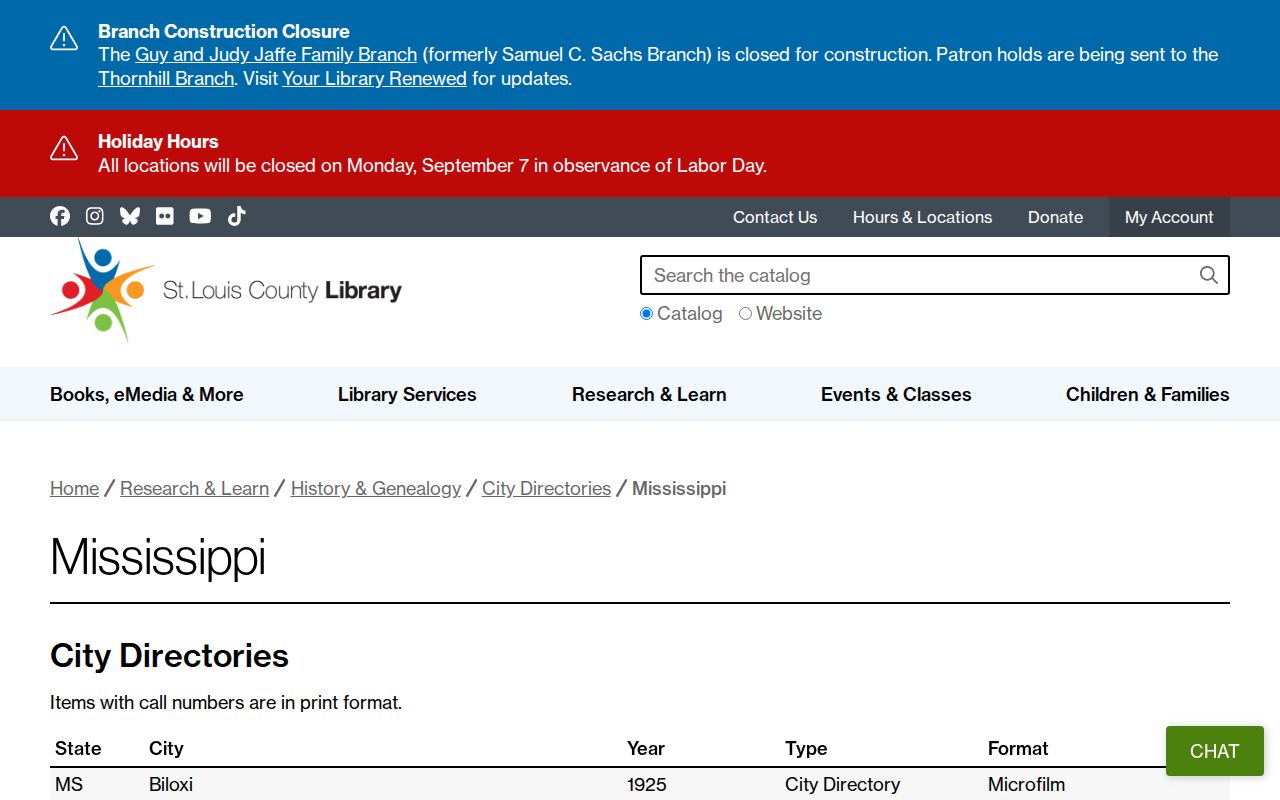
The catalog view helps plan a year-by-year request. The volume itself remains the authority for a household detail.
Tupelo Mississippi Room Research
The Helen Foster Purvis Mississippi Room sits at Lee County Library. It gives a Tupelo residents directory search somewhere physical to land. This special collection sits on the second floor. It gathers books, microfilm, maps, scrapbooks, digital files, photographs, audio, and video under one roof. Nothing circulates. Staff let patrons view, access, and sometimes copy items. Copying falls within copyright limits, item condition, and their instructions. Genealogy holdings include family histories, city and county histories, and cemetery records. These pair well with a street directory or resident lookup when a name needs a second source.
You will find the library at 219 N Madison Street in Tupelo. The Mississippi Room sits inside the same system. Posted hours run Monday, Tuesday, and Thursday from 9:00 to 8:00. Wednesday, Friday, and Saturday hours run from 9:00 to 5:00. A quick call to 662-841-9027 saves a wasted trip if you need a specific reader or reel. The library's public page names no directory years, telephone books, yearbooks, or obituary-index dates for the room. Ask staff directly.
- 1885: Franklin Square Library appears in the library history timeline.
- 1935: the Lee County Library Association formed after earlier local library efforts.
- 1942: the first Mississippi bookmobile, Eve, made its first trip.
- 1957: the Lee-Itawamba library system formed.
The Mississippi Room's collection description lays out the local materials that can back up a Tupelo residents directory lookup.

Maps, scrapbooks, and microfilm supply local context whenever a directory address or name in Tupelo needs corroboration from another record.
Reading a Tupelo City Directory Entry
Not every Tupelo volume carries every mark, so read with care. General guides to city directories describe their common structure. The front matter of the actual volume is the real authority. There the publisher explains its abbreviations. It also says whether the book includes an alphabetical list, a numerical street guide, a reverse telephone section, or all three. Check that first before trusting any entry.
| Name | Record the spelling, initials, and any relationship notation exactly as printed. |
|---|---|
| Address | Capture house number and street, then compare the street form with nearby years. |
| Telephone | When included, it can lead to the volume's numerical reverse-telephone section. |
| Occupation | Some directory formats include an occupation or business connection; treat it as a period listing. |
| Notation | Spouse, widow, ownership, or residence marks must be read against that volume's key. |
- Criss-cross directory
- An address-ordered or street-ordered section that starts with a location rather than a name.
- Householder index
- A numerical street guide that identifies the listed household or address entry, not every person in a dwelling.
- Abbreviation key
- The front-matter legend that explains shorthand used in that particular volume. Photograph or transcribe it with the entry.
Copy the spelling exactly. Note the publication year, page number, street, and the abbreviation key the volume uses. A later Tupelo directory can separate two residents who share a surname, but it cannot turn a commercial listing into proof that someone lived at an address on some other date.
Tupelo City Directory Reverse Sections
A Tupelo city directory usually holds more than one arrangement. USM describes three. There is an alphabetical resident list, a householder section grouped by numbered street or avenue, and a reverse-telephone section that runs by number. Each part answers a different question. The alphabetical entry begins with the person. The street entry begins with an address. A telephone sequence begins with the printed number. Whenever the volume allows it, check the same year in more than one section before trusting a single hit.
Treat the street section with care. A listed householder was not necessarily every resident in the house, and a missing number does not prove the lot sat empty. Street names and house numbers change over time. Read the entries just before and after your target, keep the page number, and, when later records are involved, compare the printed address against the legal-description or parcel trail kept by the county recorder.
USM's Mississippi city-directory guide explains the alphabetical, street, and reverse-telephone layouts and lists its Tupelo holdings.
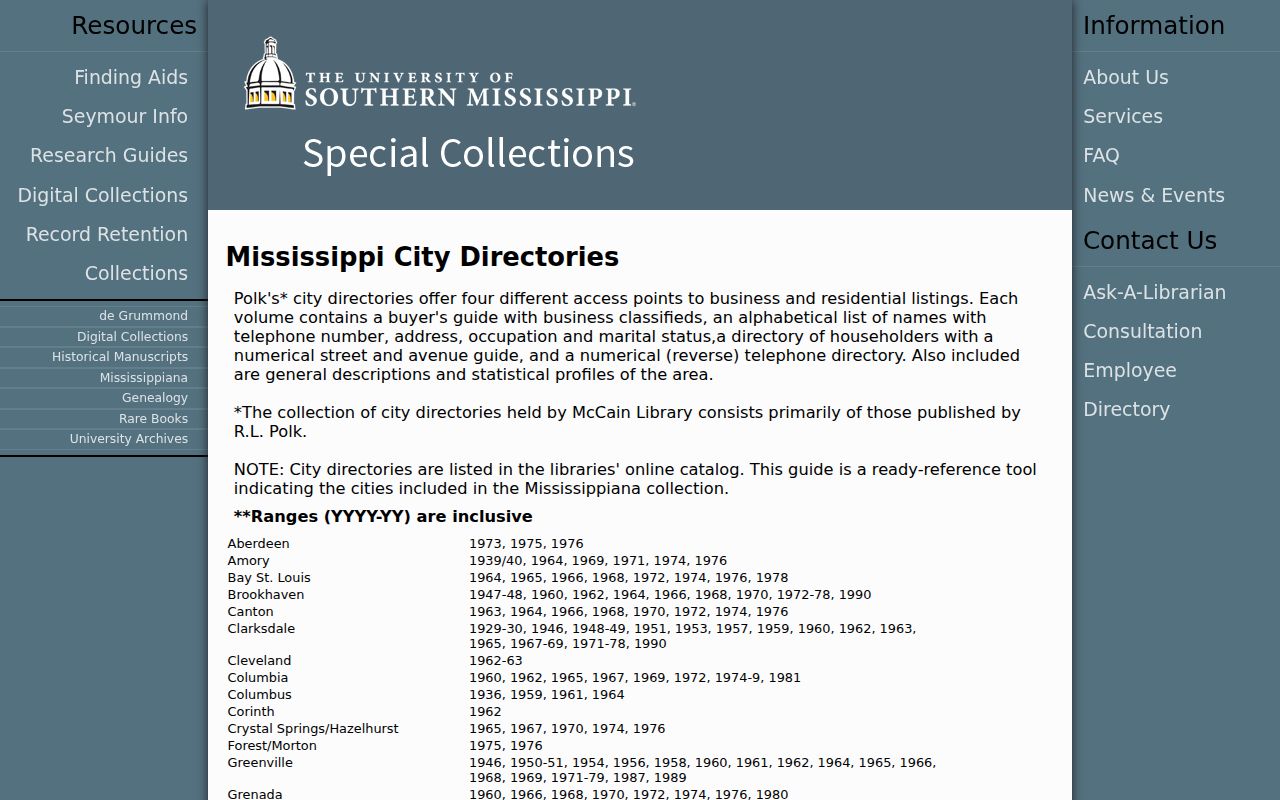
The guide saves time. It shows a researcher which section of a Tupelo directory to open before any names or addresses are copied out.
Tupelo City Directory Census Pairing
Federal census schedules stay private for 72 years, so everything through 1950 is public now. Pair a Tupelo directory year with the 1940 or 1950 census. The household often comes into fuller view. Each record answers a different question, though. The census may name a ward, township, or household number. The directory adds a telephone, a work description, or a street-listing format the census omits. Disagreement between the two is normal, not a red flag. Treat 1940 and 1950 as fixed checks for the verified directory span. Then extend to USM's 1963 and 1965 holdings with no census match expected there. A directory grew from a commercial survey. The enumeration counted the population on one census date.
Note: A directory gap does not prove a person left Tupelo or a building stood empty.
Tupelo Newspaper Trail
A newspaper can test a move, a family event, or an address clue. Address clues often come from a city directory. MDAH catalogs the Tupelo Journal on microform. Its runs are dated from 1902 through 1918 across ten entries. The title record itself spans 1876 to 1924. MDAH also lists the Tupelo Daily Journal for 1936 through 1973. That title is nonloan microform for its media room. The Mississippi Digital Library holds selections from the Northeast Mississippi Daily Journal as well.
Search a narrow date range just after the directory year. Note the title, exact date, and page, and keep a citation to the original item. An obituary can supply a date or a relationship. Still, weigh it carefully. Check it against the directory, census, or a land record. Do that before deciding two similar names belong to one person.
Tupelo Map Companion
Sanborn sheets earn their keep beside a city directory. The question is often a structure and its street context rather than the people alone. Tupelo and East Tupelo sheets are listed for 1889, 1894, 1899, 1903, 1909, 1914, 1919, 1924, and 1929. A 1929 sheet was corrected to 1964. The Library of Congress record for June 1889 covers two sheets. Its digital files are public domain.
East Tupelo labels deserve care. A historical city label may not match a current mailing-city label at all. The April 5, 1936 tornado destroyed much of Tupelo. Maps, newspapers, later directories, and parcel records can sequence a replacement structure. That disaster does not mean any particular directory entry or record was lost.
Trace Tupelo City Directory Families
A household trail holds up when it preserves what each source actually says. Start with the surname and an approximate year. Copy every Tupelo directory appearance exactly as printed. Let the address carry you into the same volume's street or householder section. Pair the directory year with the nearest public census year, then bring in newspapers, cemetery material, probate records, or deeds only to test one specific transition at a time.
- Find the earliest verified directory appearance and copy the year, page, spelling, street, telephone, and abbreviations.
- Move forward through available years, noting only documented address, name, or notation changes.
- Read the street or reverse section for the same year, then compare nearby numbers without inferring a full household.
- Pair the closest directory year with the 1940 or 1950 census and retain the census place and enumeration details.
- Use a dated newspaper, obituary, probate item, or deed to test an apparent move, death, or transfer.
Lee County's courthouse burned in 1873. It burned again in 1902. Replacement buildings were finished in 1874 and 1904. Which record groups were destroyed or reconstructed remains unstated. So a missing index entry should push you toward a catalog, microfilm, alternate spelling, or legal-description search. Draw no conclusion about the family from it alone.
Keep each collection's limits in your notes. The SLCL listing supports a reported 1940–1960 microfilm range, while USM names 1963 and 1965 holdings; neither source confirms a continuous local publication run. The Mississippi Room offers a local route to related material. Yet its public inventory gives no complete city-directory shelf list. Read each symbol, spouse notation, or ownership mark in the specific Tupelo volume before describing it, since markings vary from book to book.